

By Marianne Meindertsma
Project management and workplace-learning professional focused on making work clearer, more effective, and slightly less chaotic.
10-minute read
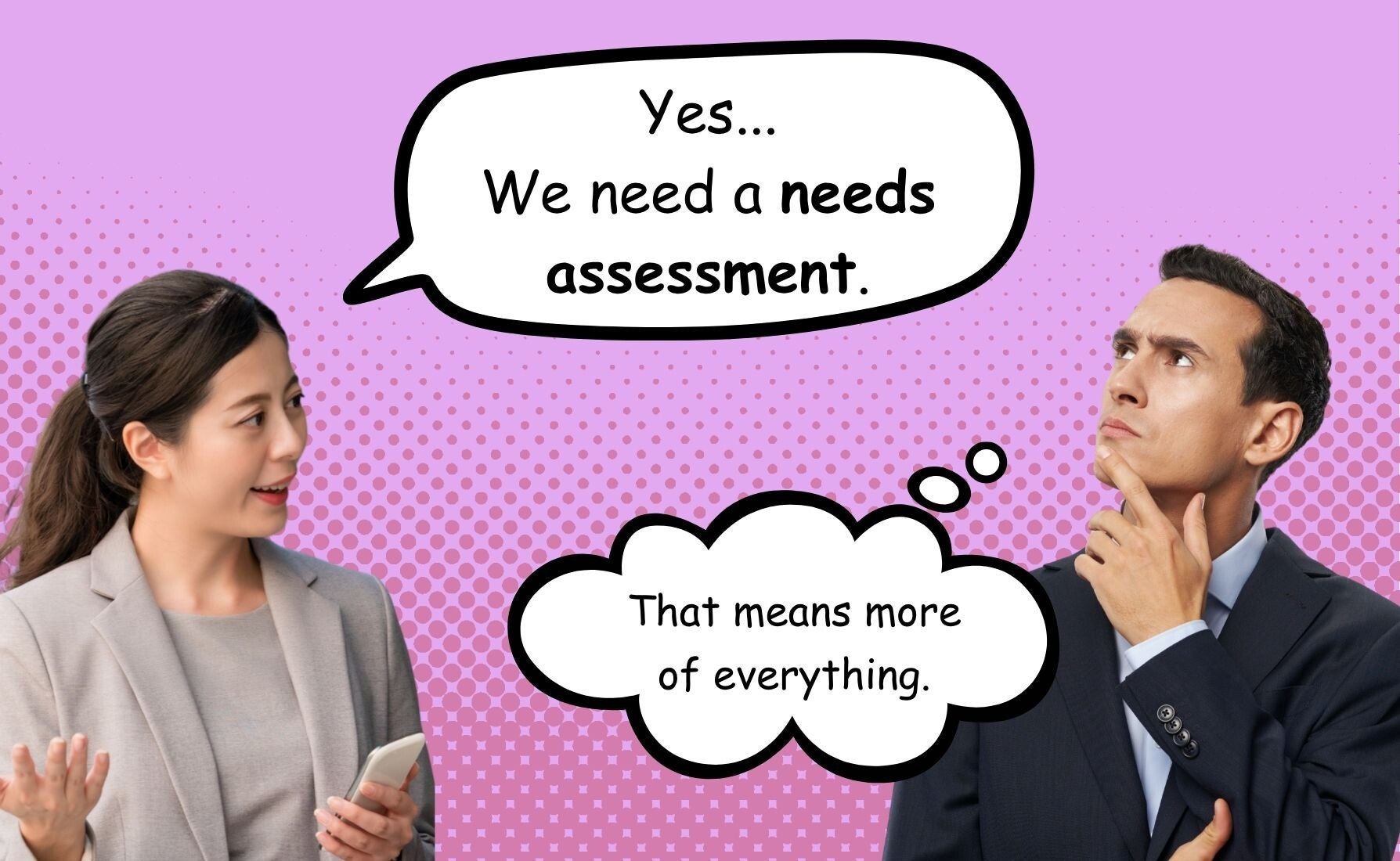
A leader brings you a problem and, in the same conversation, hands you the solution:
- “We need a new training program.”
- “We need to replace the system.”
- “We need a better onboarding process.”
- “We need everyone to communicate more effectively.”
You suspect the proposed solution may not address the real problem, so you recommend a needs assessment. Your boss hears something different: More meetings. More surveys. More analysis. More time before anyone does anything.
This is where many needs assessments lose support—before they begin. The problem is not necessarily that leaders oppose evidence-based decision-making. They may simply believe the situation is already understood, the solution is obvious, or the analysis will cost more than it contributes.
To gain approval, do not try to sell your boss on the merits of the needs-assessment process. Sell the value of making a better decision before the organization commits significant time, money, and credibility to a solution.
Your boss does not need to love needs assessments
Your boss doesn't need to be enthusiastic about assessment models, data-collection methods, or performance-improvement terminology.
Your boss needs confidence that the assessment will improve a consequential decision.
The most persuasive case is straightforward:
- A real gap exists.
- The cause has not been verified.
- Acting on an assumption creates financial and operational risk.
- The proposed assessment is focused, proportionate, and time-bound.
- Leadership will receive practical options, not more questions.
- The findings will establish how success should be measured.
Start with the business risk, not the methodology
“Needs assessment” is meaningful language to performance-improvement and talent-development professionals. To a busy executive, it may sound like an internal procedure that delays implementation.
Begin with the decision the organization is about to make and the risk of making it with incomplete information.

For example:
"Before we invest in a full training program, I would like to confirm whether the performance gap is primarily caused by a lack of knowledge or skill. If the problem stems from the process, system, incentives, workload, or unclear expectations, training alone won't fix it."
The International Society for Performance Improvement (ISPI) places analysis at the beginning of performance-improvement work. Its standards call for practitioners to identify a performance gap, need, or opportunity; examine the factors contributing to it; and determine what requirements must be met before recommending an intervention (ISPI, n.d.).
A request for training may reveal:
- Employees know what to do but do not have enough time to do it.
- The written procedure conflicts with the actual workflow.
- Managers are reinforcing different expectations.
- The technology makes the desired behavior unnecessarily difficult.
- Employees lack timely feedback or access to essential information.
- The performance standard itself has never been clearly defined.
Training may still be part of the answer. It should not become the answer simply because it was the first idea proposed. Brown (2002) warned that organizations that develop training without first assessing the need risk providing too much training, too little training, or training that misses the point entirely.
Connect the assessment to a result your boss already cares about
Your boss is unlikely to approve an assessment because it represents good professional practice. Approval becomes more likely when the assessment is tied to an existing priority.
Connect it to something already receiving leadership attention, such as:
- Reducing errors or rework
- Improving customer satisfaction
- Shortening cycle time
- Increasing adoption of a new system
- Reducing employee turnover
Instead of saying:
We should conduct a needs assessment before designing the program.
Use a business-focused request:
Before we build the program, I want to identify what is causing the 18 percent error rate and determine which causes we can realistically correct. That will help us focus the budget on the changes most likely to improve accuracy.
The second version connects the assessment to an observable business result. It also tells leadership what decision the findings will support.
The Association for Talent Development (ATD) describes a needs assessment as a comparison between current conditions and desired business results. Its guidance emphasizes that the process can clarify performance gaps, challenge assumptions, prioritize solutions, and provide data to evaluate success (ATD, 2021).
The assessment is easier to defend when it is positioned as part of achieving a business result—not as a separate research exercise competing with the work.
Make the assessment feel appropriately sized
One of the fastest ways to lose executive support is to propose an assessment that sounds larger than the problem.
Not every performance issue requires an organization-wide survey, dozens of interviews, extensive observation, and a 60-page report. A needs assessment should be rigorous enough to support the decision, but its scope should reflect the size, uncertainty, cost, and risk of that decision.
If the proposed initiative is small and reversible, a rapid assessment may be sufficient. If it involves a major technology purchase, regulatory exposure, large-scale training development, or a significant change to how people work, deeper analysis is easier to justify.
Offer a defined plan:
- What question will the assessment answer?
- Which groups or processes will be examined?
- What information will be collected?
- How long will the assessment take?
- How much employee time will it require?
For example:
"I propose a two-week assessment focused on the customer-service team. I will review three months of quality data, interview the department manager and five employees, observe the current workflow, and compare the findings with the expected performance standard. You will receive a summary of the verified gaps, likely causes, solution options, and recommended measures of success."
Explain exactly what leadership will receive
“Conduct an assessment” describes an activity. Leaders approve deliverables and decisions more readily than activities. Therefore, defining the output before asking is more likely to result in an approval.
A useful needs-assessment summary might include:
- The desired business or performance result
- The current level of performance
- The verified gap between the two
- Evidence about the likely causes
- Groups, systems, or processes affected
- Constraints that could limit improvement
- Training and non-training solution options
- The expected benefits, costs, and risks of each option
- Recommended next steps
- Measures for determining whether the selected response works
This framing is consistent with Project Management Institute (PMI) guidance on business analysis. PMI describes business analysis as identifying needs, evaluating potential solutions, and managing requirements so that investments deliver expected benefits. Its research also connects mature business analysis practices with stronger stakeholder engagement, higher-quality requirements, and better project outcomes (PMI, 2017).
Show that the assessment could accelerate the work
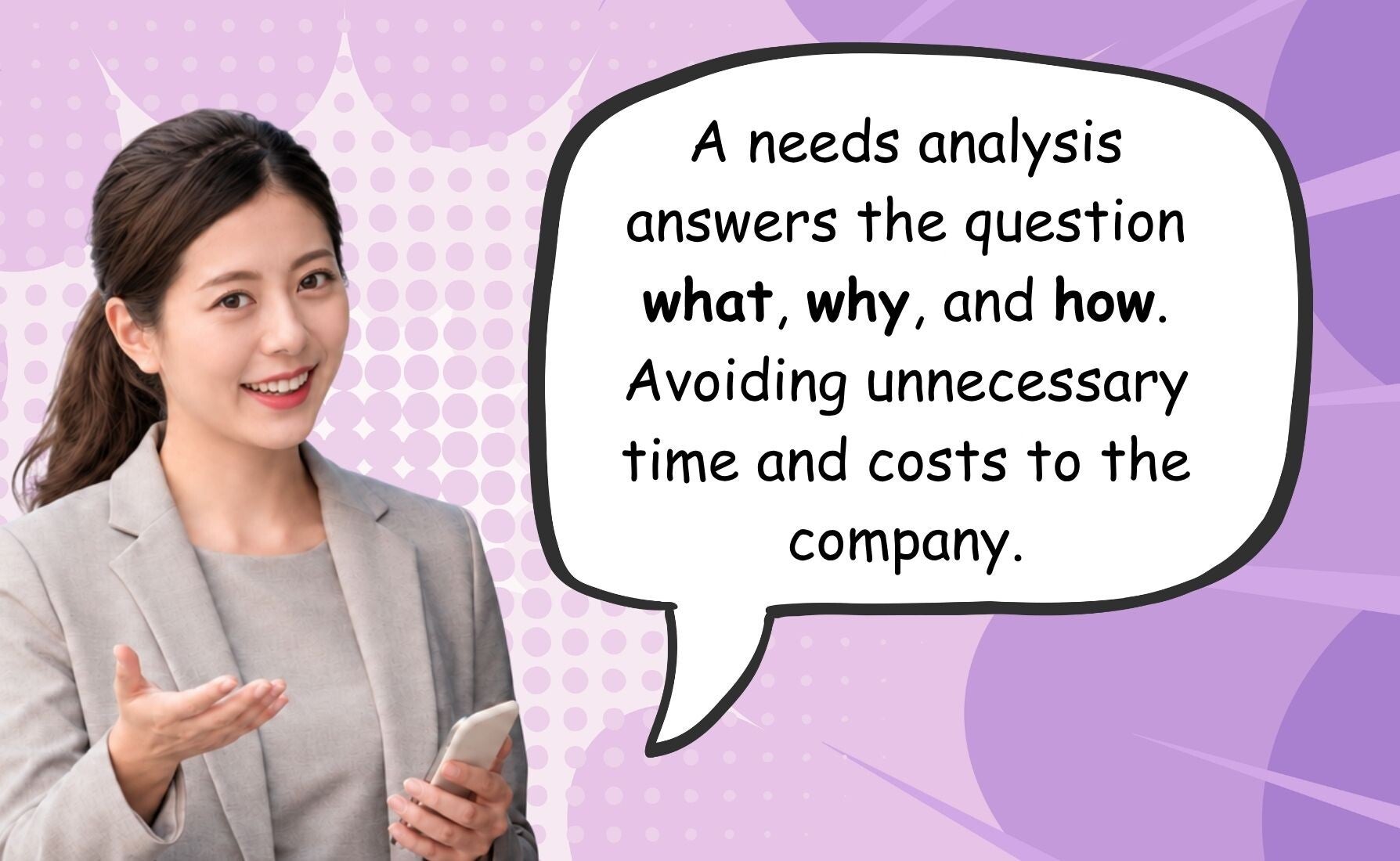
A focused needs assessment can prevent teams from spending weeks developing materials, configuring technology, or revising processes based on assumptions that later prove incorrect. It can also reveal where the team already has enough information to proceed.
The science of workplace training consistently treats analysis as part of a larger system that includes design, delivery, transfer, and evaluation. Effective training depends on understanding what must be learned, who needs it, the environment in which the learning will be applied, and the organizational conditions that support performance (Salas et al., 2012).
Your message to leadership should therefore be:
This assessment is not intended to delay action. It is intended to reduce rework and help us move more confidently once we act.
You can strengthen the case by proposing parallel work. While collecting information, the team may be able to:
- Gather existing materials and performance data
- Document the current workflow
- Confirm stakeholder expectations
- Identify quick fixes that do not depend on the final recommendation
- Prepare a project schedule with decision points
- Define preliminary success measures
- Address an urgent symptom while investigating the broader cause
Present options, not one predetermined recommendation
A needs assessment should not be a ceremonial exercise conducted to validate a solution that has already been chosen. If your proposal sounds like, “Let me conduct an assessment so I can prove we need the training program I want to build,” your boss may reasonably question the analysis's value. Explain that the assessment will compare feasible alternatives.
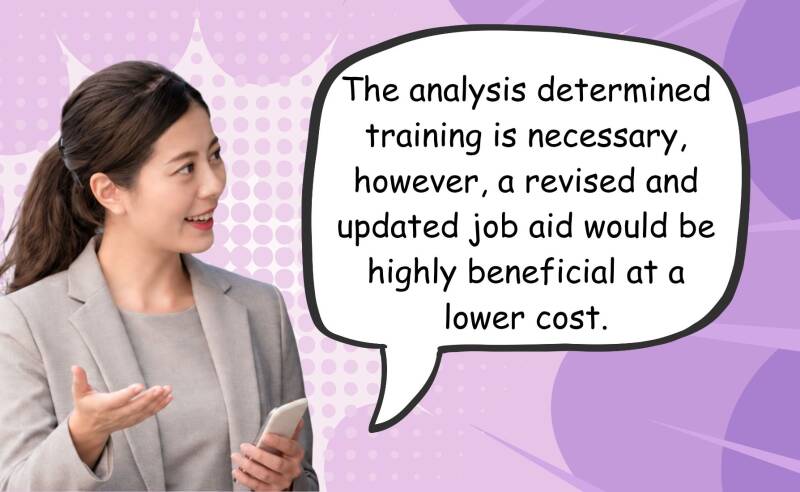
Those alternatives might include:
- Training
- Job aids or performance support
- Process simplification
- Technology changes
- Clearer role expectations
- Manager coaching
- Better feedback
- Revised incentives
- Staffing or workload adjustments
- A combination of interventions
- No action at this time
PMI recommends that a business case communicate the reason for an investment, present viable options, and clarify the value the organization expects to receive (PMI, 2017).
Giving leadership options makes the assessment more useful and more credible. It also shows that you understand the organization has constraints. The theoretically ideal solution may not be affordable, timely, or practical. A strong assessment distinguishes between what could improve performance and what the organization can realistically implement.
Remember:
A needs assessment is not a request to delay the work. It is a request to make sure the work is worth doing.
Helpful tips to consider
1. Address the objections before your boss raises them
Most objections to a needs assessment are predictable.
“We already know what the problem is.”
Respond with: We have good evidence of the outcome. I would like to verify the causes before we select the response.
“We do not have time for this.”
Respond with: I am proposing a limited assessment designed to answer the most important questions within two weeks. We can also begin the low-risk preparation work while the assessment is underway.
“Just give them training.”
Respond with: Training is appropriate when people need knowledge or skill. The assessment will confirm what employees need to learn and identify any workplace conditions that could prevent them from applying it.
“This sounds expensive.”
Respond with: I will use existing data first and limit new data collection to the gaps that affect the decision. The assessment will cost less than developing and implementing a solution that does not address the cause.
“We need action, not another report.”
Respond with: The final deliverable will be a decision brief with prioritized options, costs, risks, and recommended actions—not a report that simply restates the problem.
These responses acknowledge the concern rather than dismissing it. They also return the conversation to the decision leadership needs to make.
2. Ask for a small, specific commitment
Do not end the conversation with a vague request for support.
Ask for defined authorization:
- What you need
- How long you need it
- Who will be involved
- What the organization will receive
- When the next decision will occur
- What you are not asking leadership to approve yet
A limited commitment feels safer than approving an open-ended analysis project.
3. A 60-second pitch you can adapt
Here is a concise version for a meeting:
We have identified a meaningful performance problem, but we have not yet confirmed what is causing it. Before we invest in a full solution, I recommend a short needs assessment focused on the business result we need to improve. I will use existing data first, speak with the people closest to the work, and identify whether the gap is primarily related to knowledge, process, technology, expectations, resources, or another factor. Within two weeks, I will return with evidence, practical options, estimated tradeoffs, and measures of success. This will help us invest in the right response and reduce the risk of paying for a solution that treats the symptom instead of the cause.
Adjust the language, scale, and timeline to fit the situation. Do not promise a two-week turnaround if the decision genuinely requires more analysis.
For the Work Behind Better Decisions
Practical journals for professionals who know the requested solution is not always the right solution.

